An afternoon in Bomonti
A photographer’s Istanbul, a former brewery and a live-music stage: an afternoon that connects the city’s industrial past with its cultural life now.
Before you go
- Time needed
- An afternoon for the museum and a meal; add an evening for Babylon.
- Admission
- Ara Güler Museum is free. Babylon performances are separately ticketed.
- Museum hours
- Tue–Sat 10am–6pm; Sun noon–6pm. Closed Monday.
- Getting there
- M2 Osmanbey, Rumeli exit; allow around 10–15 minutes on foot.
Practical information checked:
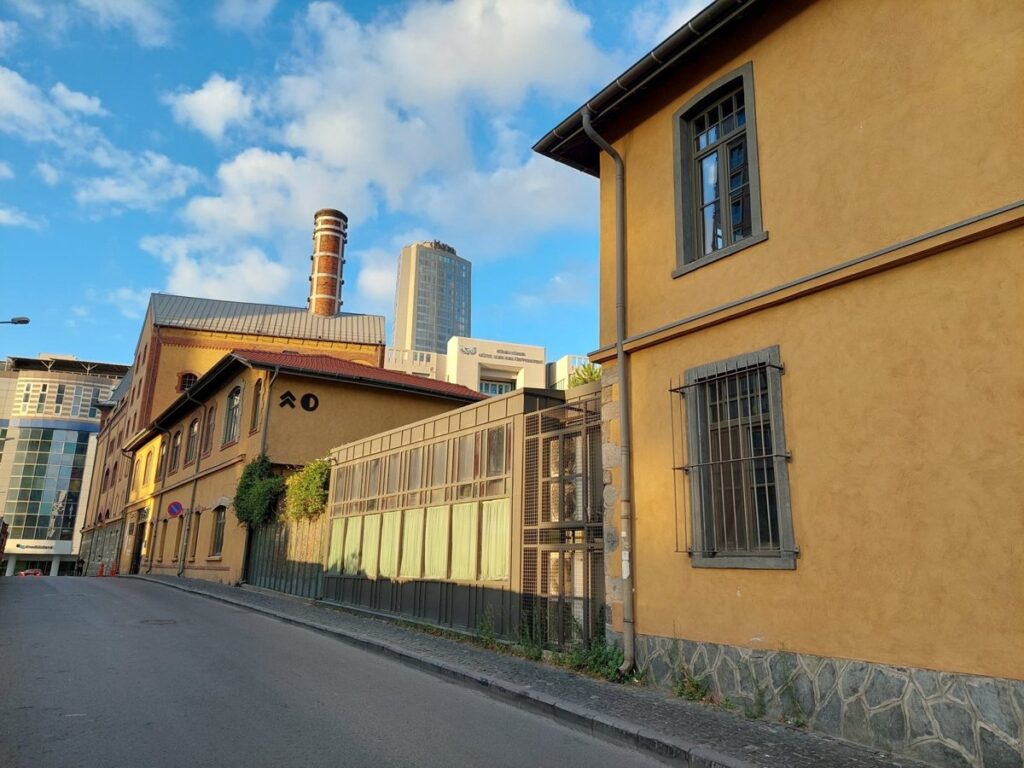
The former Bomonti brewery, September 2023.
Photo: Ayhan Gence · Photo credits
A different kind of Istanbul landmark
Bomonti’s most useful landmark is not a dome or a minaret but a brewery chimney. Around it, the former factory buildings now hold a photography museum, restaurants and a concert venue. The combination makes an afternoon here more than a convenient cluster of addresses: it brings together an Istanbul that made things, an Istanbul recorded in photographs and an Istanbul still finding new music to listen to.
The brewery took its name from the Swiss Bomonti brothers, whose business began in 1890. That name passed into the surrounding neighbourhood. Today, the industrial buildings survive within a very different city, and the contrast is part of their appeal. This is not an intact factory museum, nor should it be mistaken for a preserved working-class quarter. Bomontiada is a contemporary cultural and commercial complex that has found a new use for an old industrial setting.
Come if you would like a break from imperial Istanbul without giving up history altogether. Photography provides the strongest reason to make the journey; a meal and a performance can extend it. There is no need to buy a concert ticket simply to justify an afternoon, and no need to drink beer to appreciate the site.
Ara Güler’s Istanbul and beyond
The Ara Güler Museum opened here on 16 August 2018, the photographer’s ninetieth birthday, with Güler himself present. It draws on an archive rather than presenting one permanently fixed set of famous pictures. Check the current exhibition before going, especially if you have visited before.
Güler began working in journalism in 1950 and went on to photograph for international publications including Time, Life, Paris Match and Stern. His association with Istanbul can obscure the range of that career. He photographed well beyond the city, and his work belongs to the history of photojournalism as well as to Istanbul’s visual memory.
For a visitor, the useful question is not simply whether a photograph shows a street you recognise. Look at what occupies the frame: who is working, who is waiting, how much room the people have in relation to the buildings around them. Compare a photograph’s date with the Istanbul outside. You do not need to know the names of every district to notice that the city is made of occupations, gestures and daily arrangements as much as architecture.
The captions help put these scenes in context. Dates and locations can separate streets that survive from places that have changed, while Güler’s portraits and work outside Istanbul show the breadth of his photographic career.
Look at the building between the exhibitions
Back outside, the chimney, masonry and large factory façades deserve a pause of their own. They belong to a different scale of work from a neighbourhood shop. Looking at them after the photography exhibition also changes the question slightly: not only what Istanbul used to look like, but which parts of it are kept and what they become.
The courtyard is the place to take that pause. You can use the complex as a compact afternoon rather than a launchpad for an exhausting tour of Şişli. Museum, courtyard and a meal are enough if you want a shorter day. Allow longer if you tend to spend time with photographs, and leave the evening open unless there is a particular performance you want to hear.
For food on site, The Populist is an optional restaurant-and-brewery stop chosen for its place in the former brewery complex, not a quiet museum café or an essential Istanbul food experience. Its menu centres on burgers, smoked meats and stone-oven pizzettas. That gives you a clear idea of the meal: substantial food before music, rather than a survey of Turkish cooking. Check the menu and prices before deciding whether to stay in the complex.
The Bomontiada branch is at Birahane Sokak 1. Published hours are noon–midnight Sunday to Thursday and noon–1am Friday and Saturday. If you have tickets for later, reserve enough time to eat without turning dinner into a race against the doors opening.
Let the music choose the evening
Babylon began in Asmalımescit in 1999 and moved to Bomontiada in 2015. Its history belongs to Istanbul’s live-music life, not merely to this redevelopment. The programme is the reason to stay: choose an artist or sound that interests you rather than assuming that any night here will offer the same experience.
Use Babylon’s programme to choose an event for your evening. Check the artist, ticket conditions, door time and performance time; they are not interchangeable. A photography exhibition followed by music can make a satisfying day, but the museum does not stay open because a show is happening later.
Babylon opens on event days. Its general policy is 18-plus and usually standing, with event-specific exceptions possible. Bring identification. For access requirements, consult the venue information and contact the team before booking rather than assuming that an available lift settles every part of your visit.
Putting the afternoon together
Start with the museum, leave time around the former brewery and then decide whether dinner is the end of the outing or the interval before music. The museum is free and lists Tuesday–Saturday 10am–6pm and Sunday noon–6pm; it is closed on Monday. Its address is the Historic Bomonti Beer Factory, Birahane Sokak 1, F Block, Şişli.
For the approach, take the M2 to Osmanbey and use the Rumeli exit. Babylon estimates about ten minutes on foot; allow a little more to orient yourself and find the correct building. Check your return transport separately if you are staying late.
The shared address makes the afternoon easy to arrange: visit the museum during its opening hours, eat in the complex if the menu appeals, and stay for Babylon only when the programme gives you a reason. Photography is enough to anchor a shorter visit; a concert turns the same destination into an evening out.
For another photography or art visit, see our museum guide; for what is on during your stay, check the events calendar.