Samatya and Yedikule
An Armenian church and a neighbourhood square lead towards the city’s great walls: an afternoon between the life inside Istanbul and the gateway that once announced it.
Before you go
- Time needed
- Half a day, with time for a meal.
- Stations
- Kocamustafapaşa for Samatya; Yedikule for the fortress, on the Sirkeci–Kazlıçeşme line.
- Fortress
- Closed Mondays; reserve the fortress visit before travelling. Aim for an early-afternoon slot rather than the end of the day.
- Address
- Yedikule Hisarı, Yedikule Meydanı Sokak, Fatih.
Practical information checked:
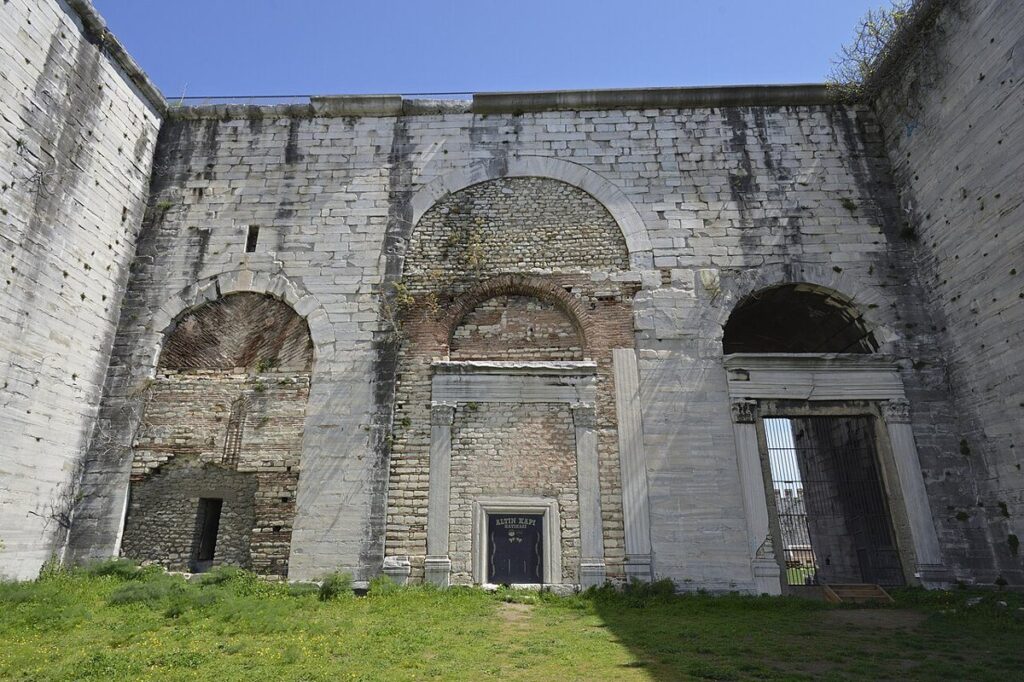
The Golden Gate at Yedikule, 2023.
Photo: Dosseman · Photo credits
A neighbourhood square and an imperial gateway
On the western side of the historic peninsula, Samatya’s square and Armenian church lead into a walk towards Yedikule’s walls. Surp Kevork was once the central patriarchal church; at the fortress, the Byzantine Golden Gate survives within an Ottoman enclosure. These are substantial parts of the city’s history, joined by neighbourhood streets and a useful lunch stop.
Choose this half-day when you want to explore the peninsula beyond Sultanahmet, particularly if Armenian Istanbul or the city walls interest you. Our Suriçi guide covers that broader setting.
The main planning constraint is Yedikule’s reservation requirement. Arrange that first, then fit the square, church surroundings and lunch around your visit.
Samatya, before the fortress
Make Samatya Meydanı your first pause after arriving at Kocamustafapaşa station. It gives you a convenient place to orient yourself before walking to Surp Kevork, with the option of lunch before or after the church stop.
If you stop for fish around the square, check whether the price is per portion or by weight. Lunch is optional; the square and the church give this part of the route its focus.
From the square, continue to Surp Kevork Armenian Church, also known as Sulumanastır, on the Marmara Caddesi side of the neighbourhood. Its importance is greater than an attractive exterior might suggest. According to the Armenian Patriarchate’s account, the church became the central patriarchal church after the Ottoman conquest and retained that role until 1641.
The church has been damaged by fire and rebuilt, so its history is longer than the surviving fabric alone suggests. Its former patriarchal role makes it an important stop for understanding the Armenian community’s place in Ottoman Istanbul.
Treat Surp Kevork as a living church, not a guaranteed walk-in attraction. If it is closed, the exterior and its position in the neighbourhood still give the stop meaning. Enter only when welcomed, observe any instructions and avoid photographing worshippers. Do not plan the whole afternoon around unconfirmed interior access.
Yedikule: a gate within a fortress
At Yedikule, look for the meeting of two structures rather than simply counting towers. The Byzantine land walls and the Golden Gate belonged to Constantinople’s defences and ceremonial life. After the conquest, Mehmed II added towers and enclosed a fortress within this older system. The Ottoman building did not replace the Byzantine threshold so much as absorb it.
The Golden Gate once formed part of the ceremonial approach to the city. Thinking of an imperial arrival changes the way you read its scale: this was not only a practical opening through a wall. It was architecture intended to make entering the capital an event.
The fortress subsequently served several purposes, including an imperial treasury and a prison. Its use as a prison added a very different role to a site built around the city’s ceremonial entrance.
Restoration is another layer of the visit. Fatih Municipality describes work on the walls, towers and earlier remains within the enclosure. Expect the route and accessible areas to reflect the work in progress rather than an idealised complete circuit. Follow the marked visitor route, ask which towers can be entered and choose shoes with grip. If stairs are a difficulty, confirm the usable route before reserving.
Let the reservation determine the order
The simplest sequence is Kocamustafapaşa station, Samatya Meydanı, Surp Kevork, Yedikule Hisarı and Yedikule station. Allow roughly four hours with lunch and the fortress, adjusting the day around your confirmed admission.
Reserve Yedikule before travelling. The municipal contact directory describes reservation-only visits and lists 9am–6pm; the venue page gives 9am–5pm. Both list Monday closure. Call +90 212 453 1453, extension 2210, to confirm the slot, admission charge and last entry. An early-afternoon booking avoids relying on either closing time.
If the available slot is in the morning, reverse the afternoon and finish in Samatya. That leaves lunch free of the need to reach a timed fortress visit.
Joining the two places
Between the church and the fortress, use the neighbourhood streets rather than heading for the coastal highway. The walking itinerary includes the square and church as stops. Set aside around an hour for the street section with pauses, excluding the meal and fortress. It is not a confirmed step-free route.
For a shorter walk, return to Kocamustafapaşa station after Samatya and take the Sirkeci–Kazlıçeşme service towards Kazlıçeşme to the next station, Yedikule. The Transport Ministry’s line overview confirms both stops. At Sirkeci, distinguish this local service from the through Marmaray line by checking the destination and platform signs.
A good place to stop
Yedikule station is the practical finish after the fortress. If you have reversed the route for a morning reservation, finish with the square and lunch in Samatya, then return from Kocamustafapaşa.